Warning: Not Safe For Work
Contains images of male and female nudity.
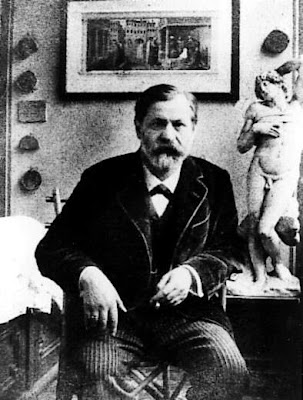
 Freud by Andy Warhol


 Mithra slaying the bull: the son murders the father
 Freud’s Totem and Taboo: The Psychological Roots of Religion, or Why God the Father Has To Murder God the Son

Return with us now to the thrilling days of yesteryear, in the Dark Ages before Prozac, Xanax, Klonopkin and Wellbutrin, when psychologists asserted that man had a conscious mind and responsibility for his actions, entailing awareness and free will—back when people believed in Freud and thought man had a soul, rather than an easily-rearranged complex of neurotransmitters.

Now, of course, we’re enlightened (if a little disoriented). In his essay, “Sorry, But Your Soul Just Died,” Tom Wolfe discredited Freudianism, saying it was invalidated by the advent of lithium, which was able to cure manic-depressives instantly who had been resistant to psychoanalysis for years. A recent article, Researchers fight for psychotherapy's survival, highlights the current controversy going on in psychology and psychiatry.

 The famous couch of dreams in Vienna
However, I’m an old-fashioned Puritan (as my first name, Wolcott, connotes), and I believe in free will. And as I argue in the essay that follows, I maintain that there are still mysteries of the human soul (and human culture) that cannot be explained, or alleviated, by psychopharmacology.

Freud’s Totem and Taboo: The Psychological Roots of Religion, or Why God the Father Has To Murder God the Son

Sigmund Freud wrote Totem and Taboo: Resemblances Between the Mental Lives of Savages and Neurotics to explain the psychological origins of religion. Considered one of the landmarks of twentieth-century intellectual history, it offers some of the most radical ideas ever offered in the study of religion. Freud asserts that belief in magic is based entirely on psychological principles. He echoes Sir James George Frazer, author of The Golden Bough: "men mistook the order of their ideas for the order of nature, and hence imagined that the control which they have, or seem to have, over their thoughts, permitted them to have a corresponding control over things" (see endnote 12).
 The imaginary nameless fear that pursues us all
Freud goes on to argue that “we may venture to compare the various evolutionary stages of man's conception of the universe with the stages of the libidinous evolution of the individual….the animistic phase corresponds in time as well as in content with narcissism, the religious phase corresponds to that stage of object finding which is characterized by dependence on the parents, while the scientific stage has lists full counterpart in the individual's state of maturity where, having renounced the pleasure principle and having adapted himself to reality, he seeks his object in the outer world” (see endnote 18).

But perhaps his most radical analysis is saved for his interpretation of the Crucifixion, where he analyzes Christ’s death at the hands of his Father in Oedipal terms, followed by his contrast of Christianity with its major competitor, Mithraism, in terms of masochism and sadism.

In writing Totem and Taboo, Freud draws heavily on research done previously in anthropology, sociology, and history. To arrive at his theory, he formulates his interpretations of the above fields in light of his own personal school of psychoanalysis. Yet he admits the limitations of such an approach, while utilizing it.
The reader need not fear that psychoanalysis, which first revealed the regular over-determination of psychic acts and formulations, will be tempted to derive anything so complicated as religion from a single source. If it necessarily seeks, as it is duty bound, to gain recognition for one of the sources of this institution, it by no means claims exclusiveness for this source or even first rank among concurring factors. Only a synthesis from various fields of research can decide what relative importance in the genesis of religion is to be assigned to the mechanism which we are to discuss; but such a task exceeds the means as well as the intentions of the psychoanalyst. (1)

Despite this statement, Freud still believes that psychoanalysis can make a unique contribution to the study of religion. By purporting to solve many of the questions of the origin of religion in the course of his investigation, he suggests that perhaps only psychoanalysis can provide the answers to the problems of religion. In relation to his inquiry into the origin of incest-dread, he makes himself clear enough when he says, "Into this darkness psychoanalytic experience throws one single ray of light." (2)

The thrust of his study is this: the psyche, expressed through religious trappings, continues to influence man into the modern era. By investigating primitive cultures, we can trace these influences to their root. Conversely, we can understand the origins and significance of these influences by analyzing their manifestations in contemporary neurotics. Specifically he concentrates on pursuing the origins and significance of two taboos, those prohibiting murder and incest, which have remained to this day the two great antisocial crimes.
 Paris Hilton and her sister playacting at mocking the taboo of incest
First Freud establishes the strength of taboo restrictions.

The taboo restrictions are different from religious or moral prohibitions. They are not traced to a commandment of a god, but really they themselves impose their own prohibitions; they are differentiated from moral prohibitions by failing to be included in a system which declares abstinences in general to be necessary and gives reasons for this necessity. The taboo prohibitions lack all justification and are of unknown origin. Though incomprehensible to us they are taken as a matter of course by those who are under their dominance. (3)


In psychological terms, from the above passage, taboos sound suspiciously like deep-seated repressions. Freud elaborates:
But the real sources of taboo lie deeper than in the interests of the privileged classes. "They begin where the most primitive and at the same time the most enduring human impulses have their origin, namely, in the fear of the effect of demonic powers." "The taboo, which originally was nothing more than the objectified fear of the demonic power thought to be concealed in the tabooed object, forbids the irritation of this power and demands the placation of the demon whenever the taboo has been knowingly or unknowingly violated." (4)


"As pointed out elsewhere, spirits and demons were nothing but the projection of primitive man's emotional impulses," Freud writes. (5)

After citing extensive anthropological data on primitive taboos, Freud articulates the basis of his argument:
He who approaches the problem of taboo from the field of psychoanalysis, which is concerned with the study of the unconscious part of the individual's psychic life, needs but a moment's reflection to realize that these phenomena are by no means foreign to him. He knows people who have individually created such taboo prohibitions for themselves, which they follow as strictly as savages observe the taboos common to their tribe or society. If he were not accustomed to call these individuals "compulsive neurotics" he would find the term "taboo disease" quite appropriate for their malady. Psychoanalytic investigation has taught him the clinical etiology and the essential part of the psychological mechanism of this compulsion disease, so that he cannot resist applying what he has learnt there to explain corresponding manifestations in folk psychology.
 Famed self-proclaimed neurotic Woody Allen, who evidently had a problem meeting girls
There is one warning to which we shall have to give heed in making this attempt. The similarity between taboo and compulsion disease may be purely superficial holding good only for the manifestations of both without extending into deeper characteristics. Nature loves to use identical forms in the most widely different biological connections as, for instance, for coral stems and plants and even for certain crystals or for the formation of certain chemical precipitates. Assuredly would it be both premature and unprofitable to base conclusions relating to inner relationships upon the correspondence of merely mechanical conditions. We shall bear this warning in mind without, however, giving up our intended comparison on account of the possibility of such confusions. (6)

The brilliant Oscar Levant made a career out of his neurosis in the Fifties
Freud cites some very convincing evidence. Savages fear that taboos can be transferred by touching (the contagion theory).


This transferability of the taboo reflects what is found in the neurosis, namely, the constant tendency of the unconscious Impulse to become displaced through associative channels upon new objects. Our attention is thus drawn to the fact that the dangerous magic power of the mana [a spirit, an impersonal force residing in people, animals, and inanimate objects] corresponds two real faculties, the capacity of reminding man of his forbidden wishes, and the apparently more important one of temping him to violate the prohibition in the service of these wishes. Both functions reunite into one; however, if we assume it to be in accord with a primitive psychic life that with the awakening of a memory of a forbidden action there should also be combined the awakening of a tendency to carry out the action. Memory and temptation then again coincide. We must also admit that if the example of a person who has violated a prohibition leads another to a same action, the disobedience of the prohibition has been transmitted like a contagion, just as the taboo is transferred from a person to an object, and from this to another. (7)

In a subsequent passage, Freud discusses mourning guilt among savages and their death wishes directed toward their peers. While his peers are living, the savage bears an ambivalent attitude toward them; he both loves and hates them.

The taboo of the dead also originates from the opposition between the conscious grief and the unconscious satisfaction at death. If this is the origin of the resentment of spirits [feared by the primitive man] it is self-evident that just the nearest and formerly most beloved survivors have to fear it the most. (8)

Freud compares this ambivalence to the love-hate relationships that we all bear to those we know, but which are exaggerated in neurotics.

By assuming a similar high degree of ambivalence in the emotional life of primitive races such as psychoanalysis ascribes to persons suffering from compulsion neurosis, it becomes comprehensible that the same kind of reaction against the hostility latent in the unconscious behind the obsessive reproaches of the neurotic should also be necessary here after the painful loss had occurred. (9)
 Oedipus on stage: gouging his eyes out is, of course, symbolic castration
 A modern-dress staging of Oedipus Rex
In anticipation of his critics, Freud states:
We are probably not mistaken in assuming that such attempted explanations expose us to the reproach of attributing a most impossible delicacy of psychic activities to contemporary savages. But I think that we may easily make the same mistake with the psychology of these races who have remained at the animistic stage that we made with the psychic life or the child, which we adults understood no better and whose richness and fineness of feeling we have therefore so greatly undervalued. (10)

With this, in my opinion, Freud has established a very strong connection between the savage's dread of taboo and modern compulsion neurosis. It is the internal similarity, not the external, that makes the most overpowering evidence. But Freud does not say they are completely identical. He points out their paths of divergence:

Primitive races fear a punishment for the violation of a taboo, usually a serious disease or death. This punishment threatens only him who has been guilty of the violation. It is different with the compulsion neurosis. If the patient wants to do something that is forbidden to him he does not fear punishment for himself, but for another person. The person is usually indefinite, but, by means of analysis, is easily recognized as some one very near and dear to the patient. The neurotic therefore acts as if he were altruistic, while primitive man seems egotistical. (11)

Then Freud investigates the psychological basis for belief in magic. He comes to the startling, but entirely reasonable, conclusion that belief in magic is based entirely on psychological principles.

We can see how true Tylor's quoted characteristic of magic: "mistaking an ideal connection for a real one," proves to be. The same may be said for Frazer's idea, who has expressed it almost the same terms: "men mistook the order of their ideas for the order of nature, and hence imagined that the control which they have, or seem to have, over their thoughts, permitted them to have a corresponding control over things." (12)
As a consequence, for the savage, "In the animistic age the reflection of the inner world must obscure that other picture of the world which we believe we recognize." (13) "We are therefore prepared to find that primitive man transferred the structural relations of his own psyche to the outer world, and on the other hand we may make the attempt to transfer back into the human soul what animism teaches about the nature of things." (14) This reversal of approaches shows, if nothing else, does how much man has changed intellectually, though not emotionally.

By the same token, neurotics base their fears on the same psychological formulations as savages.

Thus the omnipotence of thought, the over-estimation of psychic processes as opposed to reality, proves to be of unlimited effect in the neurotic's affective life and in all that emanates from it.... But through this attitude as well as through the superstition which plays an active part in his life, he reveals to us how close he stands to the savage, who believes he can change the outer world by a mere thought of his.

The primary obsessive actions of the neurotic are really altogether of a magical nature. If not magic they are at least anti-magic and are destined to ward off the expectation of evil with which the neurosis is wont to begin. (15)

When this formulation is extended into the study of religion, Freud produces some fascinating ideas. Sacrifices are made to gods with the expectation that certain wishes will be fulfilled.

It would also seem as if it were the magic act itself which compels the fulfillment of the wish by virtue of its similarity to the object desired. At the stage of animistic thinking there is as yet no way or demonstrating objectively the true state of affairs, but this becomes possible at later stages when, though such procedures are still practiced, the psychic phenomenon of skepticism already manifests itself as a tendency to repression. At that stage men will acknowledge that the conjuration of spirits avails nothing unless accompanied by belief, and that the magic effect of prayer fails if there is no piety behind it. (16)

If we accept the evolution of man's conceptions of the universe mentioned above, according to which the animistic phase is succeeded by the religious, and this in turn by the scientific, we have no difficulty in following the fortunes of the "omnipotence of thought" through all these phases. In the animistic phase, man ascribes omnipotence to himself; in the religious he has ceded it to the gods, but without seriously giving it up, for he reserves to himself the right to control the gods by influencing them in some way or other in the interests of his wishes. In the scientific he has acknowledged his smallness and has submitted to death as to all other natural necessities in a spirit of resignation. Nevertheless, in our reliance upon the power of the human spirit which copes with the laws of reality, there still lives on a fragment of this primitive belief in the omnipotence of thought. (17)

Taking this idea one step further, Freud compares the three world views with the three successive stages of growth in the individual.

If we may take the now established omnipotence of thought among primitive races as a proof of their narcissism, we may venture to compare the various evolutionary stages of man's conception of the universe with the stages of the libidinous evolution of the individual. We find that the animistic phase corresponds in time as well as in content with narcissism, the religious phase corresponds to that stage of object finding which is characterized by dependence on the parents, while the scientific stage has lists full counterpart in the individual's state of maturity where, having renounced the pleasure principle and having adapted himself to reality, he seeks his object in the outer world. (18)

 As a side note, Freud makes another comparison.
 In one way the neuroses show a striking and far-reaching correspondence with the great social productions of art, religion, and philosophy, while again they seem like distortions of them. We may say that hysteria is a caricature of an artistic creation, a compulsion neurosis, a caricature of a religion, and a paranoiac delusion a caricature of a philosophical system. (19)

 In what he attempts to be his masterstroke, Freud tries to explain the historical origin of taboo restrictions, and so of modern neuroses, with the construct of the slaying of the fathers by the rebellious, sexually frustrated younger males of the prehistoric primal horde (the Neolithic clan). Recent findings have disclosed that no such primal horde ever existed in human or prehuman society, so that shoots the hell out of Freud's theory; besides, his defense of racial memory (20) is not a little dubious. Yet it is not surprising that Freud should take such tact, considering that he states openly, at the end of his book:
 In closing this study, which has been carried out in extremely condensed form, I want to state the conclusion that the beginnings of religion, ethics, society and art meet in the Oedipus complex. This is in entire accord with the findings of psychoanalysis, namely, that the nucleus of all neuroses as far as our present knowledge of them goes is the Oedipus complex. (21)
 What about my mother?
This statement fits in with Freud's theory that all neuroses have a sexual root. Subsequent psychologists, such as Jung and Carl Rogers in On Becoming a Person, have found this to be false in their treatment of neurotic patients.
 A striking graphic for a production of Oedipus
However, just because the prehistoric cause of neurosis that Freud was groping for—to prove has pet theory, admittedly—has been discredited, it is no reason that the rest of his researches, based on sound reasoning and concrete facts, should be discarded. The bulk of his ideas on religion do not have the primal horde theory as their base. In fact, little of his research connected with religion is grounded on the Oedipus complex, and even some of those are of alarming significance. For instance, he cites various case studies where he was involved in which the subjects exhibited a clear Oedipus complex. He goes on to say:
 In view of these observations we consider ourselves justified in substituting the father for the totem animal in the male's formula of totemism. We then notice that in doing so we have taken no new or especially daring step. For primitive men say it themselves and, as far as the totemic system is still in effect today, the totem is called ancestor and primal father. We have only taken literally an expression of these races which ethnologists did not know what to do with and were therefore inclined to put in the background. Psychoanalysis warns us, on the contrary, to emphasize the very point and to connect it with the attempt to explain totemism.

The first result of our substitution is very remarkable. If the totem animal is the father, then the two main commandments of totemism, the two taboo rules which constitute its nucleus—not to kill the totem animal and not to use a woman belonging to the same totem for sexual purposes—agree in content with the two crimes of Oedipus, who slew his father and took his mother to wife, and also with the child's two primal wishes whose insufficient repression or whose re-awakening forms the nucleus of perhaps all neuroses. (22)

When viewed in this light, Freud's interpretation of the Crucifixion is particularly arresting—and illuminating.
 In the Christian myth man's original sin is undoubtedly an offence against God the Father, and if Christ redeems mankind from the weight of original sin by sacrificing his own life, he forces us to the conclusion that this sin was murder. According to the law of retaliation which is deeply rooted in human feeling, a murder can be atoned only by the sacrifice of another life; the self-sacrifice points to blood-guilt. And if this sacrifice of one's own life brings about a reconciliation with god, the father, then the crime which must be expiated can only have been the murder of the father.

Thus, in the Christian doctrine mankind unreservedly acknowledges the guilty deed of primordial times because it now has found the most complete expiation for this deed in the sacrificial death of the son. The reconciliation with the father is the more thorough because simultaneously with this sacrifice there follows the complete renunciation of woman, for whose sake mankind rebelled against the father. But now also the psychological fatality of ambivalence demands its rights. In the same deed which offers the greatest possible expiation to the father, the son also attains the goal of his wishes against the father. He becomes a god himself beside or rather in place of his father. The religion of the son succeeds the religion of the father. As a sign of this substitution the old totem feast is revived again in the form of communion in which the band of brothers now eats the flesh and blood of the son and no longer that of the father, the sons thereby identifying themselves with him and becoming holy themselves. Thus through the ages we see the identity of the totem feast with the animal sacrifice, the theanthropic [both human and divine] human sacrifice, and the Christian eucharist, and in all these solemn occasions we recognize the after-effects of that crime which so oppressed men but of which they must have been so proud. At bottom, however, the Christian communion is a new setting aside of the father, a repetition of the crime that must be expiated. We see how well justified is Frazer’s dictum that "the Christian communion has absorbed within itself a sacrament which is doubtless far older than Christianity." (23)
 The symbolic value of the above interpretation is not to be ignored. If we excise the remarks about the primal horde, the passage makes perfect sense. What would I replace the remarks about the primal horde with? In their place I would simply put the Oedipus complex, the fact that on an unconscious level every child is sexually attracted to the parent of his or her opposite sex, that parent being its first encounter with, and its model of, the opposite sex.


 There is really no need for a slain primal father. There is no reason that the patricidal impulse had to be carried out; it is simply one that surfaces in every generation of humankind. And the frustration of that impulse is not the cause of every neurosis—it is merely one cause, perhaps the cause of most of the neuroses that Freud encountered; perhaps that is why he identified it as the sole origin. Like every great theorist, Freud went overboard; just because his excesses are easily identifiable is no reason to ignore the body of his lifework.
 Freud goes on to offer a theory that is dazzling in its brilliance. He reminds us that early Christianity’s chief rival was Mithraism, the religion of Roman soldiers throughout the Empire. Now Mithraism was a religion of soldiers, of men without women. It was an unashamedly homosexual religion. In fact, women were so detested in Mithraism that mothers in childbirth were bound to trees in the hopes they would die in labor. That’s how dirty women were regarded by Mithraism.
 Christianity lifted many aspects from Mithraism. Mithra was born on December 25. His birth was greeted my three Magi (Zoroastrian astrologers). Mithraism has seven sacraments.

But as Freud points out, the key myth of Mithraism is Mithra slaying the Bull. The Son slays the Father, whereas in Christianity, in the Crucifixion, the Father slays the Son. Just as Mithraism is sadistic, a religion of violent soldiers, Christianity is masochistic, a religion for woman and slaves. (Christianity triumphed in large part because it was the only religion in the ancient world at that time that accepted woman and slaves as adherents.)

"Saturn Devouring One of His Children" by Goya: Father Chronos gets hungry

The implication of Freud’s insight is staggering, and puts Christianity in an entirely new psychological and cultural light.

Without a doubt, in my mind, Totem and Taboo is a work of genius. As an integrated piece of work, is amazing. He begins the book by defining his terms and laying the basis of his argument; once the groundwork is established, he proceeds to cite strong evidence to state his case; then he sets forth his theory, making each point carefully and building on each preceding point.

As I read the book, he startled me constantly with the brilliance of his thought; some of the ideas that struck me the most I have reproduced here. Although taking an amazingly radical viewpoint, he makes a great deal of sense because of the way he presents his ideas. While his book is not the solely definitive approach to the study of religion—no approach is—his contribution delivers astonishing insights that are available nowhere else and that change completely the way we look at religion.
* * * * *


FOOTNOTES
- Sigmund Freud, "Totem and Taboo," The Basic Writings of Sigmund Freud (New York, 1965), p. 884.
- Ibid., p. 904.
- Ibid., p. 821.
- Ibid., p. 825-6.
- Ibid., p. 878.
- Ibid., p. 827.
- Ibid., p. 833.
- Ibid., p. 855.
- Ibid., p. 854.
- Ibid., p. 883.
- Ibid., p. 862.
- Ibid., p. 871.
- Ibid., p. 873.
- Ibid., p. 877.
- Ibid., p. 874.
- Ibid., p. 872.
- Ibid., p. 875.
- Ibid., p. 876-7.
- Ibid., p. 863-4.
- Ibid., p. 927-8.
- Ibid., p. 926-7.
- Ibid., p. 908.
- Ibid., p. 924-5.


BIBLIOGRAPHY
Freud, Sigmund. The Basic Writings of Sigmund Freud. Modern Library: New York. 1965.

Note: I wrote an earlier version of this essay while a sophomore at Princeton in May 1975 as Religion paper.


 The rock face of Golgotha, the hill of skulls where Christ was crucified. See the eyes? Isn't it creepy?
.jpg)

 The ossurary of Herod


 A contemporary depiction of Herod Agrippa
 Giotto's Christ Before Caiaiphas (1304-6)


 Golgotha
 The tomb of Herod
 The ancient ossuary that was recently thought to be "the tomb of Jesus"
 The garden tomb of Jesus

 The brooding skull of Golgotha: notice how the eyes never leave you


 Zalman King as Jesus in the film The Passover Plot (1976)
 A coin of the Knights Templar


