


EMERSON'S "SELF-RELIANCE": EVERY MAN FOR HIMSELF
Ralph Waldo Emerson’s classic 1841 essay “Self-Reliance” is universally cited by authorities in the field of American Studies as one of the key cornerstones of the American character. That's why I wrote an earlier version of this essay in April 1975 for a Princeton class in American Studies while a sophomore.

“Self-Reliance”’s influential philosophy links a huge number of figures in American life, from Melville’s Ahab and Bartleby the Scrivener to, in our own day, Ronald Reagan and George W. Bush. Were he to hear Emerson’s famous pronouncement, “A foolish consistency is the hobgoblin of little minds,” what would Bush do but laugh heartily in approval?

“Self-Reliance” is an incredibly provocative intellectual statement, and I have responded accordingly. There is much to be said for Emerson encouraging us to be strong and independent, and as someone from a colonial New England background, I regard some of Emerson’s exhortations are very inspirational; but there is a much darker side to what Emerson said—a position that comes close to, “Full speed ahead and the devil take the hindmost!” and, “Fuck you, jack, I’ve got mine.” It’s every man for himself.

We can’t understand the present unless we comprehend the past, and we can’t come to grips with America’s current tragic state until we fully absorb the import of what Emerson is telling us—a philosophy that promotes competition rather than cooperation, that places the desires of the individual above the needs of the community. It’s resulted in what sociologist Philip Slater called in his landmark 1970 book The Pursuit of Loneliness.

It was Guy Dubord, the author of The Philosophy of the Spectacle (1967), the bible of French Situationism and the most compelling work of radical thinking since the end of the Second World War, who pointed out in the Sixties that the two most significant commercial inventions of the twentieth century—the automobile and television—were designed to isolate people, not bring them together. To that I would add the personal computer, another means of atomizing the individual from the social mass. But, gentle reader, we wouldn’t know anything about that, would we?

Before I begin my essay, I’m presenting a series of the most notable quotes from “Self-Reliance” (illustrated, as usual, with photos), and at the conclusion of this essay, I’m reproducing the text of “Self-Reliance” itself, so you can read for yourself what I’m talking about. See if you agree with my stance.
As Jack Ruby asked Chief Justice Earl Warren during the Warren Commission hearings: “Do I sound dramatic? Off the beam?”

* * * * *
A Selection of Provocative Quotations from "Self-Reliance"
Cast the bantling on the rocks,
Suckle him with the she-wolf's teat;
Wintered with the hawk and fox,
Power and speed be hands and feet.
 The Ballad of Narayama (1983): a great Japanese film that deals with a horrifying secret reality in premodern scarcity societies--the fact that the old, the infirm, and the deformed were left in the wilderness to die when food was limited
- To believe your own thought, to believe that what is true for you in your private heart is true for all men, — that is genius.

- Trust thyself: every heart vibrates to that iron string. Accept the place the divine providence has found for you, the society of your contemporaries, the connection of events. Great men have always done so, and confided themselves childlike to the genius of their age, betraying their perception that the absolutely trustworthy was seated at their heart, working through their hands, predominating in all their being.


- And we are now men, and must accept in the highest mind the same transcendent destiny; and not minors and invalids in a protected corner, not cowards fleeing before a revolution, but guides, redeemers, and benefactors, obeying the Almighty effort, and advancing on Chaos and the Dark.

- Society everywhere is in conspiracy against the manhood of every one of its members. Society is a joint-stock company, in which the members agree, for the better securing of his bread to each shareholder, to surrender the liberty and culture of the eater.


- Whoso would be a man must be a nonconformist. He who would gather immortal palms must not be hindered by the name of goodness, but must explore if it be goodness. Nothing is at last sacred but the integrity of your own mind. Absolve you to yourself, and you shall have the suffrage of the world.

- No law can be sacred to me but that of my nature. Good and bad are but names very readily transferable to that or this; the only right is what is after my constitution, the only wrong what is against it.

- If an angry bigot assumes this bountiful cause of Abolition, and comes to me with his last news from Barbadoes, why should I not say to him, “Go love thy infant; love thy wood-chopper: be good-natured and modest: have that grace; and never varnish your hard, uncharitable ambition with this incredible tenderness for black folk a thousand miles off. Thy love afar is spite at home.” Rough and graceless would be such greeting, but truth is handsomer than the affectation of love.

- Then, again, do not tell me, as a good man did to-day, of my obligation to put all poor men in good situations. Are they my poor? I tell thee, thou foolish philanthropist, that I grudge the dollar, the dime, the cent, I give to such men as do not belong to me and to whom I do not belong.

- It is easy in the world to live after the world's opinion; it is easy in solitude to live after our own; but the great man is he who in the midst of the crowd keeps with perfect sweetness the independence of solitude.


- A foolish consistency is the hobgoblin of little minds, adored by little statesmen and philosophers and divines. With consistency a great soul has simply nothing to do. He may as well concern himself with his shadow on the wall. Speak what you think now in hard words, and to-morrow speak what to-morrow thinks in hard words again, though it contradict every thing you said to-day.

- What makes the majesty of the heroes of the senate and the field, which so fills the imagination? The consciousness of a train of great days and victories behind.


- If we cannot at once rise to the sanctities of obedience and faith, let us at least resist our temptations; let us enter into the state of war, and wake Thor and Woden, courage and constancy, in our Saxon breasts.

- The populace think that your rejection of popular standards is a rejection of all standard, and mere antinomianism; and the bold sensualist will use the name of philosophy to gild his crimes.


- And truly it demands something godlike in him who has cast off the common motives of humanity, and has ventured to trust himself for a taskmaster. High be his heart, faithful his will, clear his sight, that he may in good earnest be doctrine, society, law, to himself, that a simple purpose may be to him as strong as iron necessity is to others!

- Our age yields no great and perfect persons. We want men and women who shall renovate life and our social state, but we see that most natures are insolvent, cannot satisfy their own wants, have an ambition out of all proportion to their practical force, and do lean and beg day and night continually.

- Welcome evermore to gods and men is the self-helping man. For him all doors are flung wide: him all tongues greet, all honors crown, all eyes follow with desire. Our love goes out to him and embraces him, because he did not need it.


- Nothing can bring you peace but yourself. Nothing can bring you peace but the triumph of principles.

A CRITIQUE OF EMERSON'S "SELF-RELIANCE": EVERY MAN FOR HIMSELF
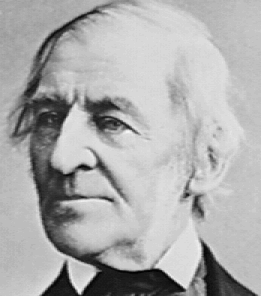
As the intellectual leader of Jacksonian America, Ralph Waldo Emerson was the godfather of the emerging American self, and his influence on American intellectual history cannot be understated. His milestone essay “Self-Reliance” is universally recognized as one of the cornerstones of the foundation of the American character.

In "Self-Reliance," Emerson sought to forge a philosophy to teach the citizens of a newly-freed nation to be independent. He preached self-reliance for the same reason he discouraged Americans from traveling abroad (1): Americans’ impulse to abandon the past (embodied by Europe) was fuelled by their social insecurity and cultural inferiority compared to Continental sophistication, which made them feel that they were a people without a background.

Like dismissing the Continent, self-reliance allowed Emerson to rationalize this insecurity. Self-reliance liberated the American psyche, just as ignoring the world outside America did, but at the same time, that energy, once released, lacking any controls that Emerson might have imposed, bore tremendous destructive potential. 
It is difficult to criticize the thought of a man who stated openly: "Speak what you think now in hard words and to-morrow speak what tomorrow thinks in hard words again, though it contradict every thing you said today." He added, "Pythagoras was misunderstood, and Socrates, and Jesus, and Luther, and Copernicus, and Galileo, and Newton, and every pure and wise spirit that ever took flesh." (3)

However, Emerson would want us to regard his ideas with the same spirit of skepticism and free inquiry that he asks us to apply to the ideas of others. Many times a beacon that can cast a strong light can also throw a stark shadow. Emerson’s philosophy might have contained darker implications than he himself realized.

He sets the tone of his argument with the two verses he uses to preface his essay. The first is notable for its statement that man is an independent being whose will can transcend, indeed determine, his destiny:
Man is his own star; and the soul that can
Render an honest and perfect man
Commands all light, all influence, all fate. (4)

The second verse celebrates a brutal Spartan attitude towards the treatment of the individual, in the hope that it will foster what we would call today social Darwinism.
Cast the bantling on the rocks,
Suckle him with the she-wolf's teat,
Wintered with the hawk and fox,
Power and speed be hands and feet. (5)

These two strains of thought, the transcendence of the will and social Darwinism, dominate “Self-Reliance.”
Emerson hopes that through the power of the will, the individual can transcend his present state of being and achieve one of higher integrity and truth. He is aware of the real state of human nature in his society, but he refuses to accept it.
Our age yields no great and perfect persons. We want men and women who shall renovate life and our social state, but we see that most natures are insolvent, cannot satisfy their own wants, have an ambition out of all proportion to their practical force and do lean and beg day and night continually. (6)

Yet, in believing that greatness calls for every man, he fails to see that he too is asking people to rely on "an ambition out of all proportion to their practical force." In reference to the average man, he writes,
To him a palace, a statue, or a costly book have an alien and forboding air, much like a gay equipage, and seem to say like that, "Who are you, Sir?" Yet they all are his, suitors for his notice, petitioners to his faculties that they will come out and take possession. (7)


In calling upon men to embark on grand adventures, he fails to understand that they may be doomed to the same failure, and for the same reason, because of bad luck or simply because of lack of talent. So he is surprised and disgusted that, "If our young men miscarry in their first enterprises they lose all heart." (8)
He does not realize that perhaps such failure is crushing because the competitor's expectations are unrealistic. In Emerson's eyes, these people just lack spunk.

Not surprisingly, his ideals are self-reliant men who radiate confidence. "Familiar as the voice of the mind is to each, the highest merit we ascribe to Moses, Plato and Milton is that they set at naught books and traditions, and spoke not what men, but what they thought." (9) "What makes the majesty of the heroes of the senate and the field, which so fills the imagination? The consciousness of a train of great days and victories behind." (10) By exhorting his readers to aim solely for grand and grandiose achievements, Emerson leaves no place in his ideals for failure. He denies a tragic view of life.


The end result of this tremendous confidence is supposed to be transcendence. "This is the ultimate fact which we so quickly reach on this, as on every topic, the resolution of all into the ever-blessed ONE." (11)

When good is near you, when you have life in yourself, it is not by any known or accustomed way.,.. The soul raised over passion beholds identity and eternal causation, perceives the self-existence of Truth and Right, and calms itself with knowing that all things go well...

Life only avails, not the having lived. Power ceases in the instant of repose; it resides in the moment of transition from a past to a new state, in the shooting of the gulf, in the darting to an aim. This one fact the world hates; that the soul becomes; for that forever degrades the past, turns all riches to poverty, all reputation to a shame, confounds the saint with the rogue, shoves Jesus and Judas equally aside. (12)

The danger of Emerson's self-reliance is that its mystical exultation exhilarates the self, causing one to believe "all things go well" and thus denying a tragic view of life; plunges one into the present moment to the exclusion of the experience learned from the past and the possibilities inherent in the future; and worst of all, institutes moral relativism. Here transcendence joins social Darwinism, for as one comes to believe that, "No law can be sacred to me but that of my nature," (13) one becomes like the imaginary willful little boy (Tom Sawyer?) whom Emerson praises as an ideal of independence: "He cumbers himself never about consequences, about interests; he gives an independent, genuine verdict. You must court him; he does not court you." (14)

The basis of all relationships becomes self-interest; before one acts, one asks, What have you done for me lately? Nowhere does this sentiment emerge more clearly than in the following passage:
Then again, do not tell me, as a good man did to-day, of my obligation to put all poor men in good situations. Are they my poor? I tell thee, thou foolish philanthropist, that I grudge the dollar, the dime, the cent I give to such men as do not belong to me and to whom I do not belong. (15)

When dealing with human suffering, Emerson asks us to follow this dictum:
Discontent is the want of self-reliance; it is infirmity of will. Regret calamities if you can thereby help the sufferer; if not, attend your own work and already the evil begins to be repaired. Our sympathy is just as base. We come to them who weep foolishly and sit down and cry for company, instead of imparting to them truth and health in rough electric shocks, putting them once more in communication with their own reason. (16)
 "For every Stoic was a Stoic; but in Christendom where is the Christian?" (17) asks Emerson. The answer is, Certainly not in Emerson, who apparently has forgotten Christian charity and that we are all our brother's keeper. His self-reliance is now revealed to be naked self-interest, to the exclusion of the needs of all others. Such a philosophy will produce situations such as Melville described in his short story, "Bartleby the Scrivener," where a sensitive young man withdraws completely from the world, eventually starving himself to death, because no one cares; in fact, the above passage ("Discontent...") could well have been voiced by the lawyer who is responsible for Bartleby's fate. (See my essay "Bartleby the Scrivener: Who Cares?")

In this light, Emerson's self-reliance has deep implications for the individual's relations with both others and his society. "As soon as the man is at one with God, he will not beg."' (19) Indeed, he will demand relationships from others with total confidence in the rightness of his own feelings, never considering that his feelings might be wrong.
Live no longer to the expectations of these deceived and deceiving people with whom we converse. Say to them, "O father, O mother, O wife, O brother, O friend, I have lived with you after-appearances hitherto. Henceforward I am the truth's..... I must be myself. I cannot break myself any longer for you, or you.... If you are noble, I will love you; if not, I will not hurt you and myself with hypocritical attentions. If you are true, but not in the same truth as with me, cleave to your companions; I will seek my own.” (20)


Similarly, the self-reliant individual considers his society as a whole to be his adversary rather than his ally.
Society everywhere is in conspiracy against the manhood of its members. Society is a joint-stock company, in which the members agree, for the better securing of his bread to each shareholder, to surrender the liberty and culture of the eater. The virtue in most request is conformity. Self-reliance is its aversion. (21)
Emerson is quite aware he’s rejecting the idea of the social contract here. He proposes a community (whether it could be called a society is questionable) comprised of individuals seeking only their own interests and never considering that of the body politic; he seems to ignore that all societies, merely to function, must impose a certain amount of conformity in the form of consensus.
If he was unaware of the consequences of such a social arrangement, then we certainly are aware, for we are its inheritors. The outcome is a fragmented society of alienated individuals pursuing their own ends solely, crushed by failure and often left unsatisfied by success.


However, Emerson anticipated his critics and supplied them with this answer:
The populace think that your rejection of popular standards is a rejection of all standards, and mere antinomianism; and the bold sensualist will use the name of philosophy to gild his crimes.

But the law of consciousness abides.... I have my own stern claims and perfect circle. It denies the name of duty to many offices that are called duties. But if I can discharge its debts it enables me to dispense with the popular code. If any one imagines that this law is lax, let him keep its commandment one day.
And truly it demands something godlike in him who has cast off the common motives of humanity and has ventured to trust himself for a taskmaster. High be his heart, faithful his will, clear his sight, that he may in good earnest be doctrine, society, law, to himself, that a simple purpose may be to him as strong as iron necessity is to others! (22)

No doubt Emerson was sincere; this critique assumes that; but the folly of his assumptions is plain. His is a Romantic view of human nature, and totally unrealistic. He believes that man, a vessel of frailty, illusion, and irrationality, can be entrusted with the responsibility of godhood. What man has the right to assert that he possesses "something godlike in him"? What man can claim of himself that "High be his heart, faithful his will, clear his sight"? Most of all, what man is equipped to be a "law, to himself"?

Human history, especially in our century, has been peopled with such men, and it is not unfair to criticize Emerson's Romantic beliefs in light of their death at the hands of the twentieth century, for his worship of destructive self-interest and his offhanded lack of concern for others is evidence of his own very human weakness. In Emerson's own time, Melville certainly detected these same flaws in his thinking, to the extent that he personified the darker implications of the above passage in the character of Ahab.


It is a valid question to ask whether Emerson was only voicing the underlying assumption that this country has always been based upon, rather than formulating any new philosophical creed. Since the days of the first settlers, Americans have always had to depend wholly on themselves. In America a man has to stand alone. An inability to do so implies weakness.
The consequences of the self-reliance Emerson presents have been disastrous. Socially and economically, Americans are obligated to establish their self-worth purely on the merits of their financial success and worldly fame, resulting in our desperate drive toward competition—and corruption—and coupled with this fact, this impulse toward independence has left Americans stranded in spiritual isolation.

As a result, America is an emotionally sterile land. How many of us actually know the members of our families? With how many of them are we true friends? (As Sinclair Lewis wrote in Babbitt, "Babbitt loved his mother, and sometimes he rather liked her..." [23])

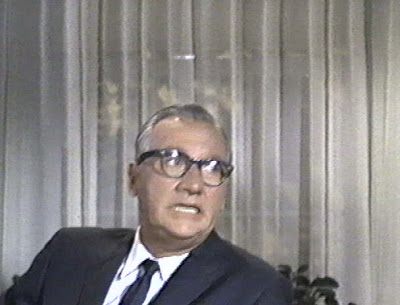
The brilliant American character actor Edward Andrews played George Babbitt in Elmer Gantry (1960), directed by Richard Brooks and starring Burt Lancaster. If only Andrews had been able to star in a film adaptation of Babbitt itself! What masterpieces have eluded us! (Imagine Marlon Brando as Jake Barnes in a 1955 production of The Sun Also Rises. Or as Jay Gatsby.)
Emerson concludes "Self-Reliance' by admonishing us to ignore the role of Fortune, or personal tragedy, in our lives, by simply imposing our will hard enough; without the aid of others, he tells us, we can determine the direction of our lives.
Nothing else matters. "Nothing can bring you peace but yourself," he says. "Nothing can bring you peace but the triumph of principles." (24) Unfortunately, the principles of self-reliance are empty and their peace, barren.


Paul Newman as Hud (1963), an amoral, brutal, selfish Texas rancher and a classic Emersonian "self-reliant" individual--a riveting portrayal of the birth of the new American fuck-youism, which started with Goldwater, changed into Reagan, and then mutated into George W. Bush
* * * * *

ENDNOTES
- Ralph Waldo Emerson, "Self-Reliance," The Selected Writings of Ralph Waldo Emerson (New York, 1950), p. 164.
- Ibid., p. 152.
- Ibid.
- Ibid., p. 145.
- Ibid.
- Ibid., p. 161
- Ibid., p. 145.
- Ibid., p. 153.
- Ibid., p. 154.
- Ibid., p. 154.
- Ibid. p. 159.
- Ibid., p. 158.
- Ibid., p. 148.
- Ibid., p. 146.
- Ibid., 149.
- Ibid., p. 163.
- Ibid., p. 167.
- Melville includes a passage in "Bartleby" describing the lawyer’s ruminations on Bartleby that nearly matches the sixteenth quotation of this paper from Emerson, sentiment for sentiment: "My first emotions had been those of pure melancholy and sincerest pity; but just in proportion as the forlornness of Bartleby grew and grew in my imagination, did the same melancholy merge into fear, that pity into revulsion. So true it is, and so terrible, too, that up to a certain point the thought or sight of misery enlists our best affections; but, in certain special cases, beyond that point it does not. They err who would assert that invariably this is owing to the inherent selfishness of the human heart. It rather proceeds from a certain hopelessness of remedying excessive and organic ill. To a sensitive being, pity is not seldom pain. And when at last it is perceived that such pity cannot lead to eventual succor, common sense bids the soul be rid of it. What I saw that morning persuaded me that the scrivener was the victim of innate and incurable disorder. I might give alms to his body; but his body did not pain him; it was his soul that suffered, and his soul I could not reach." Herman Melville, "Bartleby the Scrivener," The Portable Melville (New York, 1952), pp. 488-9. The similarities between the two passages are so striking that one wonders whether Melville is not consciously commenting on "Self-Reliance." However, it is entirely possible that Melville, as perceptive as he was, was merely commenting on the very same self-reliant mindset that he had perceived in his society.
- Emerson, p. 163.
- Ibid., p. 160.
- Ibid., p. 148.
- Ibid., p. 161.
- Sinclair Lewis. Babbitt (New York, 1950), p. 188.
- Emerson, p. 169.


BIBLIOGRAPHY
Emerson, Ralph Waldo. "Self-Reliance." The Selected Writings of Ralph Waldo Emerson, ed. by Brooks Atkinson. New York: The Modern Library, 1950.
Lewis, Sinclair. Babbitt. New York: The New American Library, 1950.
Melville, Herman. "Bartleby the Scrivener.” The Portable Melville, ed. by Jay Leyda. New York: The Viking Press, 1952.

Like Henry David Thoreau, Walt Whitman was greatly influenced by Emerson. Yet he infuriated Emerson by quoting the sage of Concord's private praise of Leaves of Grass on the flyleaf without his permission. Melville was simply horrified by Emerson. See his short story "Bartleby the Scrivener" and his modernist novel masterpiece The Confidence-Man
Self-Reliance
from Essays: First Series (1841)
Ralph Waldo Emerson
"Ne te quaesiveris extra."
"Man is his own star; and the soul that can
Render an honest and a perfect man,
Commands all light, all influence, all fate;
Nothing to him falls early or too late.
Our acts our angels are, or good or ill,
Our fatal shadows that walk by us still."
Epilogue to Beaumont and Fletcher's Honest Man's Fortune
Cast the bantling on the rocks,
Suckle him with the she-wolf's teat;
Wintered with the hawk and fox,
Power and speed be hands and feet.
ESSAY II Self-Reliance
To believe your own thought, to believe that what is true for you in your private heart is true for all men, — that is genius.
Trust thyself: every heart vibrates to that iron string. Accept the place the divine providence has found for you, the society of your contemporaries, the connection of events. Great men have always done so, and confided themselves childlike to the genius of their age, betraying their perception that the absolutely trustworthy was seated at their heart, working through their hands, predominating in all their being.
And we are now men, and must accept in the highest mind the same transcendent destiny; and not minors and invalids in a protected corner, not cowards fleeing before a revolution, but guides, redeemers, and benefactors, obeying the Almighty effort, and advancing on Chaos and the Dark.
Society everywhere is in conspiracy against the manhood of every one of its members. Society is a joint-stock company, in which the members agree, for the better securing of his bread to each shareholder, to surrender the liberty and culture of the eater.
Whoso would be a man must be a nonconformist. He who would gather immortal palms must not be hindered by the name of goodness, but must explore if it be goodness. Nothing is at last sacred but the integrity of your own mind. Absolve you to yourself, and you shall have the suffrage of the world.
No law can be sacred to me but that of my nature. Good and bad are but names very readily transferable to that or this; the only right is what is after my constitution, the only wrong what is against it.
If an angry bigot assumes this bountiful cause of Abolition, and comes to me with his last news from Barbadoes, why should I not say to him, 'Go love thy infant; love thy wood-chopper: be good-natured and modest: have that grace; and never varnish your hard, uncharitable ambition with this incredible tenderness for black folk a thousand miles off. Thy love afar is spite at home.' Rough and graceless would be such greeting, but truth is handsomer than the affectation of love.
Then, again, do not tell me, as a good man did to-day, of my obligation to put all poor men in good situations. Are they my poor? I tell thee, thou foolish philanthropist, that I grudge the dollar, the dime, the cent, I give to such men as do not belong to me and to whom I do not belong.
It is easy in the world to live after the world's opinion; it is easy in solitude to live after our own; but the great man is he who in the midst of the crowd keeps with perfect sweetness the independence of solitude.
A foolish consistency is the hobgoblin of little minds, adored by little statesmen and philosophers and divines. With consistency a great soul has simply nothing to do. He may as well concern himself with his shadow on the wall. Speak what you think now in hard words, and to-morrow speak what to-morrow thinks in hard words again, though it contradict every thing you said to-day.
What makes the majesty of the heroes of the senate and the field, which so fills the imagination? The consciousness of a train of great days and victories behind.
If we cannot at once rise to the sanctities of obedience and faith, let us at least resist our temptations; let us enter into the state of war, and wake Thor and Woden, courage and constancy, in our Saxon breasts.
The populace think that your rejection of popular standards is a rejection of all standard, and mere antinomianism; and the bold sensualist will use the name of philosophy to gild his crimes.
And truly it demands something godlike in him who has cast off the common motives of humanity, and has ventured to trust himself for a taskmaster. High be his heart, faithful his will, clear his sight, that he may in good earnest be doctrine, society, law, to himself, that a simple purpose may be to him as strong as iron necessity is to others!
If any man consider the present aspects of what is called by distinction society, he will see the need of these ethics. The sinew and heart of man seem to be drawn out, and we are become timorous, desponding whimperers. We are afraid of truth, afraid of fortune, afraid of death, and afraid of each other. Our age yields no great and perfect persons. We want men and women who shall renovate life and our social state, but we see that most natures are insolvent, cannot satisfy their own wants, have an ambition out of all proportion to their practical force, and do lean and beg day and night continually. Our housekeeping is mendicant, our arts, our occupations, our marriages, our religion, we have not chosen, but society has chosen for us. We are parlour soldiers. We shun the rugged battle of fate, where strength is born.
If our young men miscarry in their first enterprises, they lose all heart. If the young merchant fails, men say he is ruined. If the finest genius studies at one of our colleges, and is not installed in an office within one year afterwards in the cities or suburbs of Boston or New York, it seems to his friends and to himself that he is right in being disheartened, and in complaining the rest of his life. A sturdy lad from New Hampshire or Vermont, who in turn tries all the professions, who teams it, farms it, peddles, keeps a school, preaches, edits a newspaper, goes to Congress, buys a township, and so forth, in successive years, and always, like a cat, falls on his feet, is worth a hundred of these city dolls. He walks abreast with his days, and feels no shame in not 'studying a profession,' for he does not postpone his life, but lives already. He has not one chance, but a hundred chances. Let a Stoic open the resources of man, and tell men they are not leaning willows, but can and must detach themselves; that with the exercise of self-trust, new powers shall appear; that a man is the word made flesh, born to shed healing to the nations, that he should be ashamed of our compassion, and that the moment he acts from himself, tossing the laws, the books, idolatries, and customs out of the window, we pity him no more, but thank and revere him, — and that teacher shall restore the life of man to splendor, and make his name dear to all history.
It is easy to see that a greater self-reliance must work a revolution in all the offices and relations of men; in their religion; in their education; in their pursuits; their modes of living; their association; in their property; in their speculative views.
1. In what prayers do men allow themselves! That which they call a holy office is not so much as brave and manly. Prayer looks abroad and asks for some foreign addition to come through some foreign virtue, and loses itself in endless mazes of natural and supernatural, and mediatorial and miraculous. Prayer that craves a particular commodity, — any thing less than all good, — is vicious. Prayer is the contemplation of the facts of life from the highest point of view. It is the soliloquy of a beholding and jubilant soul. It is the spirit of God pronouncing his works good. But prayer as a means to effect a private end is meanness and theft. It supposes dualism and not unity in nature and consciousness. As soon as the man is at one with God, he will not beg. He will then see prayer in all action. The prayer of the farmer kneeling in his field to weed it, the prayer of the rower kneeling with the stroke of his oar, are true prayers heard throughout nature, though for cheap ends. Caratach, in Fletcher's Bonduca, when admonished to inquire the mind of the god Audate, replies, —
"His hidden meaning lies in our endeavours;
Our valors are our best gods."
Another sort of false prayers are our regrets. Discontent is the want of self-reliance: it is infirmity of will. Regret calamities, if you can thereby help the sufferer; if not, attend your own work, and already the evil begins to be repaired. Our sympathy is just as base. We come to them who weep foolishly, and sit down and cry for company, instead of imparting to them truth and health in rough electric shocks, putting them once more in communication with their own reason. The secret of fortune is joy in our hands. Welcome evermore to gods and men is the self-helping man. For him all doors are flung wide: him all tongues greet, all honors crown, all eyes follow with desire. Our love goes out to him and embraces him, because he did not need it. We solicitously and apologetically caress and celebrate him, because he held on his way and scorned our disapprobation. The gods love him because men hated him. "To the persevering mortal," said Zoroaster, "the blessed Immortals are swift."
As men's prayers are a disease of the will, so are their creeds a disease of the intellect. They say with those foolish Israelites, 'Let not God speak to us, lest we die. Speak thou, speak any man with us, and we will obey.' Everywhere I am hindered of meeting God in my brother, because he has shut his own temple doors, and recites fables merely of his brother's, or his brother's brother's God. Every new mind is a new classification. If it prove a mind of uncommon activity and power, a Locke, a Lavoisier, a Hutton, a Bentham, a Fourier, it imposes its classification on other men, and lo! a new system. In proportion to the depth of the thought, and so to the number of the objects it touches and brings within reach of the pupil, is his complacency. But chiefly is this apparent in creeds and churches, which are also classifications of some powerful mind acting on the elemental thought of duty, and man's relation to the Highest. Such is Calvinism, Quakerism, Swedenborgism. The pupil takes the same delight in subordinating every thing to the new terminology, as a girl who has just learned botany in seeing a new earth and new seasons thereby. It will happen for a time, that the pupil will find his intellectual power has grown by the study of his master's mind. But in all unbalanced minds, the classification is idolized, passes for the end, and not for a speedily exhaustible means, so that the walls of the system blend to their eye in the remote horizon with the walls of the universe; the luminaries of heaven seem to them hung on the arch their master built. They cannot imagine how you aliens have any right to see, — how you can see; 'It must be somehow that you stole the light from us.' They do not yet perceive, that light, unsystematic, indomitable, will break into any cabin, even into theirs. Let them chirp awhile and call it their own. If they are honest and do well, presently their neat new pinfold will be too strait and low, will crack, will lean, will rot and vanish, and the immortal light, all young and joyful, million-orbed, million-colored, will beam over the universe as on the first morning.
2. It is for want of self-culture that the superstition of Travelling, whose idols are Italy, England, Egypt, retains its fascination for all educated Americans. They who made England, Italy, or Greece venerable in the imagination did so by sticking fast where they were, like an axis of the earth. In manly hours, we feel that duty is our place. The soul is no traveller; the wise man stays at home, and when his necessities, his duties, on any occasion call him from his house, or into foreign lands, he is at home still, and shall make men sensible by the expression of his countenance, that he goes the missionary of wisdom and virtue, and visits cities and men like a sovereign, and not like an interloper or a valet.
I have no churlish objection to the circumnavigation of the globe, for the purposes of art, of study, and benevolence, so that the man is first domesticated, or does not go abroad with the hope of finding somewhat greater than he knows. He who travels to be amused, or to get somewhat which he does not carry, travels away from himself, and grows old even in youth among old things. In Thebes, in Palmyra, his will and mind have become old and dilapidated as they. He carries ruins to ruins.
Travelling is a fool's paradise. Our first journeys discover to us the indifference of places. At home I dream that at Naples, at Rome, I can be intoxicated with beauty, and lose my sadness. I pack my trunk, embrace my friends, embark on the sea, and at last wake up in Naples, and there beside me is the stern fact, the sad self, unrelenting, identical, that I fled from. I seek the Vatican, and the palaces. I affect to be intoxicated with sights and suggestions, but I am not intoxicated. My giant goes with me wherever I go.
3. But the rage of travelling is a symptom of a deeper unsoundness affecting the whole intellectual action. The intellect is vagabond, and our system of education fosters restlessness. Our minds travel when our bodies are forced to stay at home. We imitate; and what is imitation but the travelling of the mind? Our houses are built with foreign taste; our shelves are garnished with foreign ornaments; our opinions, our tastes, our faculties, lean, and follow the Past and the Distant. The soul created the arts wherever they have flourished. It was in his own mind that the artist sought his model. It was an application of his own thought to the thing to be done and the conditions to be observed. And why need we copy the Doric or the Gothic model? Beauty, convenience, grandeur of thought, and quaint expression are as near to us as to any, and if the American artist will study with hope and love the precise thing to be done by him, considering the climate, the soil, the length of the day, the wants of the people, the habit and form of the government, he will create a house in which all these will find themselves fitted, and taste and sentiment will be satisfied also.
Insist on yourself; never imitate. Your own gift you can present every moment with the cumulative force of a whole life's cultivation; but of the adopted talent of another, you have only an extemporaneous, half possession. That which each can do best, none but his Maker can teach him. No man yet knows what it is, nor can, till that person has exhibited it. Where is the master who could have taught Shakspeare? Where is the master who could have instructed Franklin, or Washington, or Bacon, or Newton? Every great man is a unique. The Scipionism of Scipio is precisely that part he could not borrow. Shakspeare will never be made by the study of Shakspeare. Do that which is assigned you, and you cannot hope too much or dare too much. There is at this moment for you an utterance brave and grand as that of the colossal chisel of Phidias, or trowel of the Egyptians, or the pen of Moses, or Dante, but different from all these. Not possibly will the soul all rich, all eloquent, with thousand-cloven tongue, deign to repeat itself; but if you can hear what these patriarchs say, surely you can reply to them in the same pitch of voice; for the ear and the tongue are two organs of one nature. Abide in the simple and noble regions of thy life, obey thy heart, and thou shalt reproduce the Foreworld again.
4. As our Religion, our Education, our Art look abroad, so does our spirit of society. All men plume themselves on the improvement of society, and no man improves.
Society never advances. It recedes as fast on one side as it gains on the other. It undergoes continual changes; it is barbarous, it is civilized, it is christianized, it is rich, it is scientific; but this change is not amelioration. For every thing that is given, something is taken. Society acquires new arts, and loses old instincts. What a contrast between the well-clad, reading, writing, thinking American, with a watch, a pencil, and a bill of exchange in his pocket, and the naked New Zealander, whose property is a club, a spear, a mat, and an undivided twentieth of a shed to sleep under! But compare the health of the two men, and you shall see that the white man has lost his aboriginal strength. If the traveller tell us truly, strike the savage with a broad axe, and in a day or two the flesh shall unite and heal as if you struck the blow into soft pitch, and the same blow shall send the white to his grave.
The civilized man has built a coach, but has lost the use of his feet. He is supported on crutches, but lacks so much support of muscle. He has a fine Geneva watch, but he fails of the skill to tell the hour by the sun. A Greenwich nautical almanac he has, and so being sure of the information when he wants it, the man in the street does not know a star in the sky. The solstice he does not observe; the equinox he knows as little; and the whole bright calendar of the year is without a dial in his mind. His note-books impair his memory; his libraries overload his wit; the insurance-office increases the number of accidents; and it may be a question whether machinery does not encumber; whether we have not lost by refinement some energy, by a Christianity entrenched in establishments and forms, some vigor of wild virtue. For every Stoic was a Stoic; but in Christendom where is the Christian?
There is no more deviation in the moral standard than in the standard of height or bulk. No greater men are now than ever were. A singular equality may be observed between the great men of the first and of the last ages; nor can all the science, art, religion, and philosophy of the nineteenth century avail to educate greater men than Plutarch's heroes, three or four and twenty centuries ago. Not in time is the race progressive. Phocion, Socrates, Anaxagoras, Diogenes, are great men, but they leave no class. He who is really of their class will not be called by their name, but will be his own man, and, in his turn, the founder of a sect. The arts and inventions of each period are only its costume, and do not invigorate men. The harm of the improved machinery may compensate its good. Hudson and Behring accomplished so much in their fishing-boats, as to astonish Parry and Franklin, whose equipment exhausted the resources of science and art. Galileo, with an opera-glass, discovered a more splendid series of celestial phenomena than any one since. Columbus found the New World in an undecked boat. It is curious to see the periodical disuse and perishing of means and machinery, which were introduced with loud laudation a few years or centuries before. The great genius returns to essential man. We reckoned the improvements of the art of war among the triumphs of science, and yet Napoleon conquered Europe by the bivouac, which consisted of falling back on naked valor, and disencumbering it of all aids. The Emperor held it impossible to make a perfect army, says Las Casas, "without abolishing our arms, magazines, commissaries, and carriages, until, in imitation of the Roman custom, the soldier should receive his supply of corn, grind it in his hand-mill, and bake his bread himself."
Society is a wave. The wave moves onward, but the water of which it is composed does not. The same particle does not rise from the valley to the ridge. Its unity is only phenomenal. The persons who make up a nation to-day, next year die, and their experience with them.
And so the reliance on Property, including the reliance on governments which protect it, is the want of self-reliance. Men have looked away from themselves and at things so long, that they have come to esteem the religious, learned, and civil institutions as guards of property, and they deprecate assaults on these, because they feel them to be assaults on property. They measure their esteem of each other by what each has, and not by what each is. But a cultivated man becomes ashamed of his property, out of new respect for his nature. Especially he hates what he has, if he see that it is accidental, — came to him by inheritance, or gift, or crime; then he feels that it is not having; it does not belong to him, has no root in him, and merely lies there, because no revolution or no robber takes it away. But that which a man is does always by necessity acquire, and what the man acquires is living property, which does not wait the beck of rulers, or mobs, or revolutions, or fire, or storm, or bankruptcies, but perpetually renews itself wherever the man breathes. "Thy lot or portion of life," said the Caliph Ali, "is seeking after thee; therefore be at rest from seeking after it." Our dependence on these foreign goods leads us to our slavish respect for numbers. The political parties meet in numerous conventions; the greater the concourse, and with each new uproar of announcement, The delegation from Essex! The Democrats from New Hampshire! The Whigs of Maine! the young patriot feels himself stronger than before by a new thousand of eyes and arms. In like manner the reformers summon conventions, and vote and resolve in multitude. Not so, O friends! will the God deign to enter and inhabit you, but by a method precisely the reverse. It is only as a man puts off all foreign support, and stands alone, that I see him to be strong and to prevail. He is weaker by every recruit to his banner. Is not a man better than a town? Ask nothing of men, and in the endless mutation, thou only firm column must presently appear the upholder of all that surrounds thee. He who knows that power is inborn, that he is weak because he has looked for good out of him and elsewhere, and so perceiving, throws himself unhesitatingly on his thought, instantly rights himself, stands in the erect position, commands his limbs, works miracles; just as a man who stands on his feet is stronger than a man who stands on his head.
So use all that is called Fortune. Most men gamble with her, and gain all, and lose all, as her wheel rolls. But do thou leave as unlawful these winnings, and deal with Cause and Effect, the chancellors of God. In the Will work and acquire, and thou hast chained the wheel of Chance, and shalt sit hereafter out of fear from her rotations. A political victory, a rise of rents, the recovery of your sick, or the return of your absent friend, or some other favorable event, raises your spirits, and you think good days are preparing for you. Do not believe it. Nothing can bring you peace but yourself. Nothing can bring you peace but the triumph of principles.
* * * * *


.jpg)
 Rex Harrison lived a life of extremes. In his youth, his outward persona tottered between that of a wellborn cultured jetsetter who, in reality, had little clout or money to his name. As his stature as an actor grew, his personal life became unsteady and insecure. Married six times, yet desperately claiming the constant love of one woman, Harrison was an electrifying mass of contradictions. Though he created a myriad of indelibly complex characters on both the stage and big screen, arguably the most compelling part he ever played was his own life.
 Reginald Carey Harrison was born to privilege in Heighton, England on March 5, 1908. In truth, there was very little about his youth that foreshadowed greatness. Reginald’s father William was a flirtatious and handsome sport who preferred the social graces to a steadfast work ethic. If William was a lax blueprint for Reginald’s upbringing, his mother, Edith more than amply balanced her husband’s wayward nature with a rigid set of finite values that she instilled in her son and Reginald’s two older sisters, Sylvia and Marjorie.
.BMP)
.BMP) At 14, Rex made his debut in the society’s production of Shakespeare’s A Midsummer Night’s Dream, and very quickly came to the realization that there was quite a bit more to acting than taking bows. To be truly great he would have to succumb to expert tutelage. For Rex, the very idea seemed distasteful. “(He was) very rebellious,” son Noel has said of his father, “He would never conform to what people expected of him to do.” Still, it was a means to an end – and so the pupil began his exercises.
At 14, Rex made his debut in the society’s production of Shakespeare’s A Midsummer Night’s Dream, and very quickly came to the realization that there was quite a bit more to acting than taking bows. To be truly great he would have to succumb to expert tutelage. For Rex, the very idea seemed distasteful. “(He was) very rebellious,” son Noel has said of his father, “He would never conform to what people expected of him to do.” Still, it was a means to an end – and so the pupil began his exercises..BMP)
 By 1927, Rex Harrison had managed a minor coup; he had become a prolific commodity – a man of envy to most others his own age and a real charmer with the fairer sex. Yet, nothing short of perfecting his craft would satisfy the egotistical actor. And so, in September of that year, Rex moved to London where he began a 12 week tour in Charlie’s Aunt. His part garnered rave reviews in the press.


 For his debut project, Rex was cast opposite Irene Dunne in Anna and the King of Siam (1946). Rex excelled as the aggressive and curmudgeonly potentate, though initially he had had misgivings about the part – even going so far as to hire an acting coach to ease him into the character. Never one to take direction well, Rex and his director, John Cromwell did not get on. In fact, on several occasions noted in the Fox memo archive, Cromwell urged Zanuck to reconsider and/or recast the part. To his credit, Zanuck quietly ignored these complaints, affording Rex his first major Hollywood success.
 of Hollywood as being a ‘difficult actor.’ Despite these backstage clashes, the film was a colossal smash hit, elevating his stature and importance in the film making community.
 In support of the negative press, Fox canceled Rex’s contract. He retreated, though not in shame, with Lily to New York City for more than a decade’s worth of solid performing on the stage; beginning with a turn as Henry VIII in Maxwell Anderson’s Anne of the Thousand Days (1949). The play ran for 288 performances and earned Rex his first Tony Award. He followed this success with Bell Book and Candle in 1950, costarring with Lily to great acclaim. The
  couple next appeared as a pair of newlyweds in the classy film comedy, The Four Poster (1951).
.jpg)

 In the meantime, 20th Century-Fox approached Rex with the prospect of co-starring in their mega-budgeted spectacle, Cleopatra (1963). Though Rex agreed to appear in the film as Caesar – turning in yet another powerful performance – his presence in the film was all but eclipsed and overshadowed by the scandalous affair between costars, Elizabeth Taylor and Richard Burton. The most expensive movie ever made to date, not even Cleopatra’s $24 million dollar box office gross could offset the film’s epic budget. For years afterward, it would remain on the Fox’s ledgers as the film that nearly sank the studio. If the release of Cleopatra did nothing to further Rex’s career, it equally did nothing to hamper it either.
 Unfortunately for Rex, his relationship with Rachel Roberts had already begun to crumble. A manic depressive with dependencies on pills and alcohol, Roberts quickly became the unmanageable portion of Rex’s life. Throwing himself into work on his latest project, The Agony and the Ecstasy (1965), Rex excelled as the unrelentingly severe Pope Julius II who commissions Michelangelo (Charlton Heston) to paint the ceiling of the Sistine Chapel. “Rex was in fact a kind of a thorny guy,” Heston relayed years later in reflection on their costarring, “There you are. But he was so good, it was worth the trouble it took.”
 CURTAIN CALLS
.jpg)
.BMP) Rex also embarked upon an ambitious roster of stage productions including Shaw’s Heartbreak House, The Kingfisher (costarring Claudette Colbert) and the 25th anniversary of My Fair Lady. “I’m at the age,” Harrison mused, “where I’ve got to prove I’m just as good as I never was.”
Rex also embarked upon an ambitious roster of stage productions including Shaw’s Heartbreak House, The Kingfisher (costarring Claudette Colbert) and the 25th anniversary of My Fair Lady. “I’m at the age,” Harrison mused, “where I’ve got to prove I’m just as good as I never was.”.BMP)
 @2007 (all rights reserved).

.jpg)


.jpg)
.BMP)


 In 1962, director
 .BMP) Reflecting on Rains as a man first, his daughter Jessica has said,
Reflecting on Rains as a man first, his daughter Jessica has said, 


.BMP)