Wednesday, August 23, 2006

LET'S HEAR IT FOR THE BOYS


A stooge in the head is worth three cheers from the heart

by Nick Zegarac

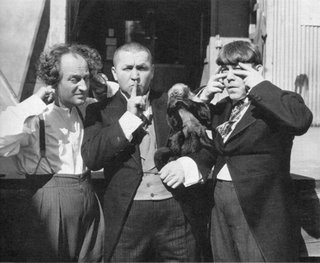
The Three Stooges are today regarded as cinematic icons; as American as apple pie, the undisputed masters of slapstick, and, as zanily unhinged as anything ever seen on the screen. If Laurel and Hardy were sublime punsters, the stooges were punch drunks. Pitted against the Marx Bros. leftist anti-establishment witty barbs, geared toward the anarchist intellectual, the stooges are low brow chuckleheads for the every man. Yet, the stooges have remained eternal – and arguably, have surpassed – their contemporary comedic legends. The endurance of one “nyuk-nyuk-nyuk” for example has managed to outlive almost all other filmed comedic bits of business put forth by rival acts, save radio hams cum film comedians Bud Abbott and Lou Costello’s ‘Who’s on First?’

Who can forget the riotous boxing tournament, when Curly (the troupe’s most popular numb skull), after hearing ‘Pop Goes the Weasel’ manages to decimate not only his opponent in the ring but also his managers, Larry and Moe; or the moment when Curly, attempting to ‘fix’ a leaky bathtub, inadvertently builds a cage around himself from plumber’s tubing. Or Curly, with a large couch coil stuck to his rump, (the other end still attached to the couch), is pulled from his oafish female dancing partner at a society party.

Curly: If her husband kills me, I'm comin' back to haunt you.

Moe: Haunt that house.

Curly: How many rooms?

Moe: Seven.

Curly: With bath?

Better still, the vignette in which Curly discovers a very feisty live oyster spewing projectile soup at him from his bowl of oyster stew. These, and many other moments, once seen are seared into the memory. Not bad for three guys with limited education who spent the bulk of their career appearing in two reel short subjects – rather than feature length films.
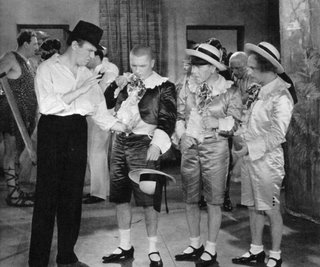

Woman - "I'm in a terrible dilemma."
Moe - "Yeah, I don't care much for these foreign cars either."
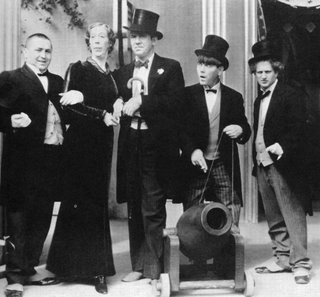

Professionally, it all began in 1908, when a feisty Moses (Moe) Harry Horwitz (then eleven) decided he had had enough with school and wanted to become an actor. There was one problem. Moses lacked even a glint of matinee idol good looks.

“Seeing my face in the mirror,” he would later recount, “covered with large jagged freckles…I would end up the ugly duckling of the Horwitz family.”

Still, he managed to finagle a gofer’s position at Brooklyn’s Vitagraph Studio on Avenue M in New York City. When asked by head of production Maurice Costello why he had consistently refused remuneration for his menial services Moses replied, “Because I’m looking for a job in films.” The ploy worked. Moses was cast in a string of bit parts for Vitagraph, including Van Dyke Brooks We Must Do Our Best (1909).

That same year, Moses (newly rechristened as ‘Moe’) met Ted Healy, the man who would amalgamate the stooges trademark humor before departing on other ventures. Healy was a bit of a drifter with greater aspirations for becoming a businessman than an entertainer. However, by 1912 Healy’s ambitions had shifted to Vaudeville and a modestly successful traveling troupe that included Moe and his brother Sam (Shemp).

The men appeared briefly in Annette Kellerman’s Diving Girls. Previously, Kellerman had made headlines for defying the odds of being stricken by polio at an early age, yet swimming the English Channel as a youth. Currently she was the star of an acquacade. But the Healy/Kellerman association ended abruptly after only one season when a contract diver fell to her death from the diver’s platform.

Still, Moe was determined. At sixteen, he lied his way into a stint aboard a traveling riverboat, The Sunflower for two seasons at a then plumb salary of $65 dollars a week. With his newfound strength as an actor, Moe reunited with Shemp for a blackface comedy relief routine: Howard & Howard – a study in black. Shemp’s draft into the armed forces briefly interrupted this lucrative venture, though afterward the two worked circuits for Loew’s and RKO until 1922. That was the year both men decided to marry; Moe to Helen Schonberger (the cousin of Harry Houdini) and Shemp to Gertrude Frank. But there was precious little time for romance.

A reunion with Ted Healy (and his wife Betty), paved the way for a new Vaudeville act – one that included aspiring comedian Larry Fine. The troupe also included the Haney Sisters – of which Larry would court and later marry the eldest, Mabel in 1927. At the outbreak of World War I, the act traveled the ardent route of playing small town venues. Larry attempted something of a breakout sketch ‘Fine and Dandy’ with a woman ironically named Winona Fine. The venture was extremely short lived. Back in the Healy fold, the act reopened as Ted Healy and his Three Southern Gentlemen, then later as Ted Healy and the Racketeers.

However, in 1927 Moe resigned himself to an official retirement from showbiz. His decision had been predicated on a deep seeded desire to prove his wife’s family – who had insisted that any marriage to an actor would never make for a stable home – wrong. After the birth of his daughter, Joan, Moe ventured into real estate.

The shift in profession proved disastrous. In an instant, his investment of $22,000 had dwindled to a meager $200.00. Another attempt at respectability, this time as the proprietor of a dried goods store, did little than to further strain the family’s financial status. Finally, Moe resigned himself to a reunion with Ted Healy – who had by this time become a rather prominent figure on the stage. The reunited group debuted in A Night In Venice (1929) – a comedic musical staged by Busby Berkeley.

A Night In Venice was a colossal success and paved the road to Hollywood in 1930 with a film offer from Fox Studios (then a precursor to 20th Century Fox). The film, Soup to Nuts (1930) was enough to convince Winnie Sheehan that the stooges were ready for the big time. However, a mere four days later the offer of a seven year contract was revoked, prompting Moe to make inquiries. What he discovered was that the contract had not included Ted Healy. Fearful that he was losing his own chance to score in films, Healy had confronted Sheehan with an impassioned plea not to sign the stooges as a solo. The rift generated between Moe and Healy was sufficient enough for the stooges to strike out on their own.


For the next several years, Healy and the new independent act of The Three Stooges (Moe, Shemp and Larry) struggled separately to find their niche. Both toured the theater circuit with their quiet animosity building. Another rupture occurred when Healy – ever more becoming a cynical drunk and embittered recluse – threatened to sue the stooges if they incorporated any bits of business from A Night in Venice into their new Vaudeville act. This pending lawsuit was settled quietly, but it did leave a bitter aftertaste for all concerned.

It was at this junction in their career that the success of Soup to Nuts began to pay off – with one caveat. It prompted more film offers to pour in but as the act Ted Healy and His Stooges. Reluctantly, the troupe reunited. However, while on tour for a live engagement at The Triangle Ball Room, Shemp received a solo film offer which Moe encouraged him to pursue. Outraged, Healy lamented that Shemp’s departure would ruin the act. But Moe had a winning replacement – his brother Jerome ‘Curly’ Howard.

With Curly in tow, Healy and the Stooges reunited on screen for Meet The Baron, Plane Nuts and Dancing Lady (all in 1933) but the partnership was from the start impossibly strained. After 1934’s cameo in Hollywood Party, Moe cornered Healy and his agent Paul Dempsey and officially broke their contract. Henceforth the new act would be known simply as ‘The Three Stooges.’

INSANITY UNHINGED

The Golden Age of Stooge-dom

by Nick Zegarac

Moe – “Are you kidding? We’re the best in the city!”
Larry – “But how are you in the country?”


The break between Ted Healy and The Three Stooges proved the beginning of one of the most successful comedy acts in film history. It also became the focus of a minor snafu in contract disputes. Signed by agent Walter Kane for Columbia Studios, studio president Harry Cohn agreed to produce one two-reel comedy featuring the stooges for which they would be paid a poultry sum of $1500.00. Under Healy’s control the boys had barely collected$100.00 per week. If the results proved a success with audiences, Cohn would sign the trio to a long term contract.

Moe signed the Columbia deal on behalf of the act. Unfortunately, across town at Universal, Larry was signing a similar deal with agent, Joe Rivkin. The wrangling between Carle Leammle Jr. (Universal’s president) and Harry Cohn was amicably resolved when Cohn discovered that he had signed their contract by only a few hours advance of the Universal deal. “You boys belong to Columbia,” Cohn told Moe.

Man - "This bed goes back to Henry the 8th."
Curly - "That's nuthin'. We had a bed that went back to Sears Roebuck the 3rd."

In June of 1934 The Three Stooges debuted in their first Columbia two-reel comedy; the musically rhymed Woman Haters written and directed by Archie Gottler.


On the strength of that short subject, Harry Cohn agreed to a long-term contract at seventy-five hundred per film and also to produce a pet project of Moe’s: ‘Punch Drunks.’ However, the Columbia deal did come with stipulations.

The first, allowed the studio to re-release the Stooges shorts without royalties paid to them. This did not mean much to the trio in 1934, but with the advent of their loan out two decades later to television a vast amount of potential earnings was denied for years to come.

Also, the Columbia deal came with a yearly renewal clause at which time the studio could simply decided to cancel their option. Columbia used this clause as a means of keeping demands for salary increases down. Every time a request came around Cohn would lament how difficult it was becoming to sell two-reelers to theaters. In reality, Columbia was exploiting the popularity of the trio to market inferior B-movies to theater owners. It would be 24 years, 194 short subjects and 5 feature films later, before Columbia would allow their option on the act to lapse.

Woman - “Do you know of the Great Wall of China?”
Curly - “No. But I know of a big fence in Chicago.”

The Columbia contract also allowed the stooges a yearly twelve week hiatus during which time they could freelance. It was during their 1935 Children’s Hospital benefit performance in Boston that the trio learned of Ted Healy’s untimely death. According to reports of the day, after lashing out in a drunken brawl and being beaten by four men outside of a nightclub, Healy was taken back to his apartment by friend and comedian Joe Frisco where he died a few days later of a brain concussion.

During the next few years The Three Stooges became an intercontinental rage, playing sold out performances at London’s Palladium, The Royal Theater and appearing in the 1939 run of George White’s Scandals on Broadway. They also toured the army/navy circuit during the war, entertaining the troupes on behalf of the Coca-Cola Company and signed a deal to appear in Harold Minsky’s new Vaudeville revival – a short lived venture made all the more brief by the advent of television.

Executioner - “You may either have your head cut off or be burned at the stake.”
Larry –
“Cut my head off.”
Curly – “Not me! I wanna be burned at the stake.”
Larry – “Why?”
Curly – “A warm stake is better than a cold chop.”


All The World’s A Stooge...or Three


To say that the late thirties and early forties were a time of prosperity for The Three Stooges is contextualizing their popularity without a sincere grasp on just how wildly popular the trio had become.

They had weathered a rough series of misfires to become the most celebrated of slapstick artists and the upswing of that career had yet to plateau. For a while, this endless tenure of revolving workload proved lucrative and satisfying. But on May 4, 1946, while relaxing between takes in a very humid soundstage, Curly Howard suffered a debilitating stroke.

Confined to the Motion Picture Country Home in Woodland Hills for care and treatment, Moe Howard regrouped the act with Shemp Howard replacing Curly. Since the early thirties, Shemp had had a modestly successful film career playing a cameo comic foil. Still, with Curly’s reputation so heavily ingrained in the act, many in the industry, including Columbia president Harry Cohn and Moe feared that audiences would never accept anyone as Curly’s replacement. Debuting the new stooges with the modestly budgeted Fright Night (1946) Moe and Columbia soon discovered that Shemp’s own brand of comedic genius was more than adequate to sustain the laughter and repartee with audiences.

The fifties was a lucrative period for The Three Stooges professionally– but a decade marred by two tragic losses that devastated the act and the artistic community. Curly Howard, who had never fully recovered from his initial stroke, suffered a series of additional strokes and suddenly passed away on January 1952 at the age of forty-nine. However, an even more disheartening blow followed a scant three years later. On Nov. 23, 1955, Shemp Howard was returning from an outing at the races and the fights with several friends when he suddenly slumped over, and with a queer sort of peaceful smile on his face, inexplicably died.

Shemp’s replacement in the act was Joe Besser, a main staple comedian on Milton Berle’s television show. But the association between Besser and the stooges proved all too brief. After only 16 short subjects, the Columbia contract was fulfilled and Besser, unable to go on tour because of his ailing spouse, was exchanged for Joe DeRita – ironically Moe’s first choice after Shemp’s death who had been under contract to Harold Minsky all along.

Unfortunately, by this time in his career, the determination that had fueled Moe’s earlier aspirations for the act had begun to fizzle. A nightclub debut of the new stooge proved an unqualified disaster. However, at roughly this same interval, Columbia Pictures had managed a minor coup in repackaging the old Stooges shorts for general release on television. These shorts created a minor sensation for children and teens who had never seen them in their original theatrical engagements and helped to revitalize interest in the act. During the summer of 1958, the stooges proved a star attraction at John Bertera’s Pittsburgh nightclub and restaurant.

This revitalization continued with three guest appearances on the Ed Sullivan and Steve Allen shows. Almost overnight, the stooges were in vogue once more, appearing as a cameo bit of comic relief for Francis Langford and even starring in their own Three Stooges Scrapbook (1960) for Columbia’s Screen Gems. Columbia also cast the stooges in their first feature length film, Have Rocket Will Travel (1961).

Their final feature, The Outlaws Is Coming (1965) ended on a bitter note. Larry suffered a stroke and was hospitalized at the Motion Picture Home. Though he made valiant attempts to regain his mobility, his recovery was never complete and on New Years day 1975 he slipped into a coma. He died one week later. Officially retired, Moe allowed Joe DeRita to pursue the idea of recasting his part and Larry’s in a ‘new’ ‘new’ stooges act that never materialized beyond the preliminary stages.

Tired and seemingly with his best days behind him, an invitation from Salem College in West Virginia afforded Moe Howard the opportunity to present reminiscences about the act to a live audience; one that proved so popular that he repeated it at New York State University to a packed 1,600 auditorium that had oversold the venue by at least 400 seats. In his seventies, Moe Howard discovered that he was more popular than ever. He appeared on Mike Douglas’ talk show three times and ambitiously pursued the college lecture circuit throughout 1974. On May 4, 1975, Moe Howard quietly passed away at his home, officially ending one of America’s most legendary comedy acts.

Since that time, The Three Stooges popularity has continued to thrive. The trio’s body of work has weathered attempts at censuring its ‘crass’ treatment of women by liberal feminism and it has withstood repeated onslaughts of censorship from civic minded groups who continue to find the stooges brand of comedy too violent yet at the same instance do not mind if their children watched the evening news.

From television revivals, through changing audience tastes and with the advent of home video and garish colorizations, the comedic legacy of The Three Stooges continues to delight old and new audiences with their rambunctious blend of raw energy and good spirited craziness. The legends have gone, but their laughter lives on.

Not bad for the ugliest duckling in the Howard house…not bad at all.

@Nick Zegarac 2006 (all rights reserved).

Thursday, August 3, 2006

ENTERING PASTERNAKIA


…that sparkling ‘wunderbar’ of musical treasures.

Check reality at the door and leave all your troubles, worries and cynicism behind.

by Nick Zegarac


It has been suggested that the musicals of producer Joseph Pasternak lack sophistication, particularly when quelled against those produced by Pasternak’s rival at MGM, Arthur Freed. The point is a moot one. That Pasternak should even be considered in the same breath as Arthur Freed is a testament to both his savvy and his foresight. It is also a silent nomination for Pasternak to assume his rightful place amongst the all time greatest motion picture producers of the 20th century.

This nomination has often been denied or, at least, eclipsed by Freed’s own illustrious tenure at the studio. Arguably, Freed’s musicals possess the hallmark of more progressive thinking; Freed’s own constant testing of the musicals’ boundaries as an art form generating some of the finest examples of as near to perfection in the genre as possible; Singin’ In The Rain, The Band Wagon, and, An American in Paris, to name but three.

Yet, in paralleling the careers of Pasternak and Freed, film historians have inculcated a great injustice on the Pasternak legacy – for each man’s body of work is comparable to the other only to the extent that both men toiled within the artistic echelons of Metro-Goldwyn-Mayer and were considered, at least for a time, the monarchs of the motion picture musical. Yet, stylistic distinctions abound.

Freed was the true Renaissance man – pursuant of the musical’s constant mutation and expansion; soliciting talent from the New York stage who had a decidedly contemporary strain. By contrast, Pasternak infinitely preferred to remain the gallant holdover from those glorious days of the prewar operetta, when politeness necessitated a libretto, a coy nod and a cultured bow.

Despite Esther Williams claim that he ate spaghetti with his hands, Pasternak was a man very much imbued with the vestiges of a 19th century doctrine for all things impeccably groomed and cultured. Hence, his passion for musicals sought to extol and embrace a time removed, rather than his own immediate present.

While Freed’s fictional musical protagonists were quite often savvy artists of the stage, Pasternak’s were almost without fail common people with no aspirations toward art but whose mundane lives were suddenly transformed and elevated into some grand and magically touched experience. Hence, while Freed’s Tony Hunter (Fred Astaire) in The Band Wagon (1953) is a world weary semi-retired hoofer, desiring a comeback as a Broadway star, Pasternak’s Johnny Donnetti (Mario Lanza) in That Midnight Kiss (1949) is little more than a truck driver who likes to sing and is shortly thereafter ‘discovered,’ thereby making him a truck driver no more.

This ultimate wish fulfillment derived from a Pasternak musical and firmly implanted in the collective cultural mindset is primarily why Pasternak’s films endure today; because they foster within an audience the ideal that no matter our station in life we may one day be called to rise from that plateau into a realm of infinite happiness. Indeed, within each musical excursion Pasternak may very well have been providing his audiences with a subliminal biography.

He was born Joseph Pasternak to Jewish heritage on September 19, 1901 in Szilágysomlyó, then a part of the Austria-Hungary empire, though currently named Şimleu Silvaniei and belonging to Romania. He immigrated as a teenager to the United States and for several years thereafter held various menial positions in the Paramount Studios commissary where he quietly absorbed and observed the daily banter of its professionals both in front of and behind the camera.

Disenchanted with his station and perhaps recognizing that he lacked a formal education to do anything else, at twenty-eight Pasternak returned to Europe where he slowly began to graduate into prominence as a film producer. As he rose through the ranks, Pasternak learned from his contemporaries, amalgamating his tutelage into a distinct style while honing the craft of film making. His success could not have been more ill timed. With the advent of the Nazis rise to power, Pasternak was forced to return to the United States in 1934. But he was no longer a fledgling and he brought with him on his return trip to Hollywood a wealth of experience that immediately caught the eye of Carl Lemmle at Universal Studios in 1936.

Recognizing the feasibility of an articulate precocious fourteen-year-old Canadian soprano Deanna Durbin, who had recently been dropped from her contract at MGM, Pasternak petitioned long and loudly to produce a movie that would showcase her talents. Initially balking at the idea, as musicals were costly in general and Universal was, at this time financially strapped, the film Three Smart Girls (1936) proved a winner. Depression audiences responded to its sugary sweet story while critics furnished accolades upon Hollywood’s latest child protégée.

Ensconced at Universal with a lucrative long term studio contract, Durbin and Pasternak cemented their popularity with Pasternak’s follow up, One Hundred Men and A Girl (1937), an even more eclectic blend of the high and low brow that went on to be nominated for 5 Academy Awards including Best Picture.

Despite a 1938 hiccup that had Pasternak casting himself as the unsuccessful Svengali-star maker to French actress Danielle Darrieux, by the end of the decade Pasternak was Universal’s most prolific producer. His innate ability to blend the heavy (or high brow) with the light and popular rekindled the public’s waning interest in the operetta – a move echoed at MGM with their wildly popular teaming of Nelson Eddy and Jeanette MacDonald. More important – Pasternak’s overriding vision had saved Universal Studios from looming financial receivership. Called upon to aid in the diminishing returns of Universal’s other big star, Marlene Dietrich, Pasternak cast the sultry German chanteuse as a fiery harlot in Destry Rides Again (1939) a seminal western/comedy that effectively deglamorized Dietrich and made her inimitable brand of intercontinental charm excitingly new and real.

However, Pasternak’s genuine forte for pseudo-classical material ultimately remained his bread and butter – though particularly at Universal. Subsequent Deanna Durbin films produced under Pasternak’s aegis all bear his unmistakable flare for operatic extravagance. In It’s A Date (1940) he furnishes Durbin with Musetta’s Waltz and Ave Maria (Pasternak would later remake the film in Technicolor and at MGM with Jane Powell as Nancy Goes to Rio 1950). In It Started With Eve (1941) Pasternak cannot help but allow Durbin the opportunity to trill several breathtaking arias despite the fact that the film’s narrative is set in the present and does not otherwise allow for such musical outbursts.

At this junction in Pasternak’s career, he had made enough of an impression on L.B. Mayer to be wooed away from Universal and over to MGM. This 1941 transition was only slightly brought on by Deanna Durbin’s increasingly temperamental nature (Pasternak himself was hardly a pussycat), her growing up and her considerable plumping out which some at the studio feared would render her unattractive to audiences. Rather, Pasternak rightfully recognized that MGM’s prominence in all aspects of motion picture production would afford him greater opportunity to develop his passion at a studio that both respected and fostered musical talents.

For example, before departing Universal Pasternak had once more attempted to work his magic as a star maker on singer Gloria Jean, an abysmal and failed attempt only partly because Jean lacked star quality – but more importantly, because Universal did not wish to acknowledge the value in cultivating ‘two’ Deanna Durbins for their stable of stars.

At MGM, Pasternak indulged his creative whims on a litany of frothy family fare often with a wartime theme to help buttress the feather weight plots. His first project, Presenting Lily Mars (1943) was one of Judy Garland’s transitional musicals. A child star of the first magnitude, whose indelible mark had already been made in The Wizard of Oz (1939), MGM allowed Pasternak to mature Garland for the title role of a small town girl who makes good on Broadway.

Pasternak next produced Thousands Cheer (1943) a film originally conceived as a modest musical romance between a rather rakish sailor, Eddie Marsh (Gene Kelly) and the colonel’s daughter, Kathryn Jones (Kathryn Grayson). Under Pasternak’s aegis, that modest premise ballooned into an all-star wartime extravaganza – easily one of the biggest and brassiest of its kind and topped by Grayson warbling of the pseudo operatic ‘United Nations on Parade’ (in actuality a variation on a Shostakovich piece).

Subsequent ventures; Song of Russia (1944), Two Girls and A Sailor (1944), Her Highness and the Bellboy (1945) and The Thrill of Romance (1945) were lucrative variations on Pasternak’s tried and proven ingredients for success. Although there were few on the backlot who contended to veer from the producer’s itinerary, The Thrill of Romance’s Esther Williams was not one to keep her opinions secret. Though her clashes with Pasternak were perhaps more reserved than the outbursts that would occur on the set of This Time for Keeps (1947) and On An Island With You (1948) the polite agreement to disagree between these two eventually led to Pasternak’s rather unfair assessment of Williams’ talent as “In the water she was a star. Outside she ain’t!”

However, one year later the producer would officially ruffle Arthur Freed’s feathers when he secured a minor coup by garnering a Best Picture Oscar nomination with Anchors Aweigh (1945); the delightfully effervescent tale of two sailors on a twenty-four hour shore leave who accidentally meet, then fall in love with, the same girl. The film costarred Gene Kelly and MGM’s own soprano, Kathryn Grayson. It also utilized one of Pasternak’s favorites – conductor Jose Iturbi in a prominent role and it marked the MGM debut of crooner extraordinaire, Frank Sinatra.

Midway through production, Pasternak ran into flack from the front office for the commissioning of a costly live action/animated sequence in which Jerry Mouse (of Tom and Jerry fame) trips the light fantastic with Kelly. Initially the sequence had been modeled with Mickey Mouse in mind. However, after making an appointment with Walt Disney – and emphatically told that Mickey Mouse would never appear in an MGM picture – Pasternak and director George Sidney recast the cartoon part with their own resident rodent.